I apologize that perhaps too many of my latest articles have covered the topic of advertising. I can justify that to myself because I feel, in today's world of almost unlimited "free" content online (either offered for free, or free through piracy), the issue of monetizing the web in a way that efficiently rewards producers of content (films, software, books, ideas, artworks) is and will continue to be one of the our great economic dilemmas. The current model is heavily based on advertising, and I feel that the monetization model of pay per click, "put everything out for free, because it's just going to be pirated anyway, then pray that someone clicks on the ads" will soon fail.
Why? As I covered in my earlier article on this topic, because if they haven't already, people will soon realize advertising has become a mark of bad quality for the advertiser. In the wired, social media fueled economy, word of mouth and the collective intelligence of the web are king. Not the word of advertising. Ask yourself, of the two following choices, who would you be more willing to trust?: a paid celebrity spokesman telling you that a product is great, or hundreds of user reviews online telling you a product is bad? If you answered the former, you must really like that celebrity.
But there's another more basic reason why advertising is a mark of bad quality. Advertising costs money. And money spent on advertising is money not spent in other areas, the areas of spending that, unlike advertising, help to actually create a good product or service.
Ask yourself the following question: When was the last time you saw a national advertisement for Harvard University? You know, just to spread the word: "Hey everybody, Harvard's a great school!" Probably not very recently.
Now ask yourself when was the last time you saw an advertisement for ITT Tech or other for-profit trade school offering community-college level education at 10 times community-college prices? I see them all the time, on TV and all over the web. These are the kinds of products and services that need to advertise: Scams, predatory lending and herbal "male-enhancement" supplements.
In other words, products and services that suck.
And speaking of sucking, advertising sucks. That is, advertising costs suck money, like leeches from an organization's funds. These funds could be used to help provide a better product or service. And in a world where social media has created 'roided up engines for the transmission of instant, global word of mouth, perhaps the better companies will find that money is more wisely spent on improving their products, rather than simply trying to convince people that their products are good. So if you see a company advertising heavily, ask yourself "why do they need to advertise so much?" and "where is the money coming from to pay for all these advertisements?" It could very well be that the heavy advertising company never counted on offering a quality product or service in the first place, and was just planning on pulling a fast one. And if you want to find out if a product is good or bad, often a quick Googling will suffice. Just watch out for those Google ads.
(Post script: Yes I am a total hypocrite for attacking the web advertising model from a blog covered in ads supplied by Google.)
Thursday, March 8, 2012
Sunday, November 20, 2011
The Economics of the Worst Meal I Ever Ate

(I'll be the first to tell you that this article is based on my very limited, subjective experience eating once at a single restaurant, and my theories on the economic and political implications of this one meal are total generalizations based on extremely limited evidence; evidence based on a sample size of 1. Nonetheless, there might be something to my theory. Read on.)
When I ordered the very worst meal I ever ate, I was on a lunch break from jury service. I had left the downtown LA courthouse and walked a couple of blocks in a random direction looking for a restaurant. I walked into what turned out to be a grubby, nasty place and ordered a hot dog and what they called "homemade mac and cheese", basically a pile of inedible, greasy, flavorless, stringy slop. I try not to waste food, but I couldn't make it through this. It was definitely the most disgusting, seemingly half-assed meal I have ever seen prepared.
Disregarding the possibility that I came into the restaurant on a very very bad day, how would such a substandard restaurant stay in business? I'll theorize with two words: Jury Duty. Think about it, every weekday, thousands of people coerced by the legal duty to perform jury service converge upon the courthouse, and they all need to eat. Like me, many of them will just walk down a block in a random direction, stop at the first restaurant they see, eat there, and possibly prop up the fortunes of a restaurant that would otherwise fail. But this is not simply a matter of an increased volume of foot traffic outside. If that were the case, restaurants next to all highly visited areas would have lesser quality food, but that is clearly not true. A restaurant next to, for example a large office building that the same workers go to every day, needs to maintain high standards to keep those same people coming back. But this restaurant next to the courthouse would get a different set of suckers almost every single day. So where is their incentive to improve? Nowhere. Each day the restaurant could survive by pumping out disgusting slop for a new set of unsuspecting people called in for jury duty; people who will probably not set foot on that same block unless one day they get called back for jury service at the same courthouse. Also, word-of-mouth is inhibited. What's the use of telling your friends and neighbors about a bad dining experience in a completely different neighborhood than they live in? And while bad restaurants near the courthouse would gain benefits from this lack of word-of-mouth, the good restaurants would be harmed by this.
So, because of the (perhaps absolutely necessary and unavoidable) government coercion of people to come to courthouses, I am putting forth the theory, (arrogantly generalizing based on my own reasoning and the evidence of one bad experience) that many bad restaurants near courthouses in large urban areas probably get the benefit of a distortion of the market. The jurors are a captive audience, and have little power to move that "invisible hand" away from such nasty, disgusting restaurants.
Or do they? Perhaps the internet will come to the rescue. On websites such as Yelp, that an increasing number of jurors will have access to on their smartphones, website users can blow the lid off of the nastiness of bad restaurants such as this one, and promote the good ones. This however, depends on how widespread smartphone based restaurant reviewing becomes. It all depends on whether or not more Americans become mobile-device-addicted, whining foodies (like me). And on a completely different topic: would that be such a good thing?
Anyone else out there had any interesting juty duty lunchtime experiences, good or bad? I've got to get more evidence.
Thursday, September 22, 2011
Gotomeeting's TV Ad: Slacktivism In Action
I've been Googling and Googling and can't find any reference to the "Kenyan Water Project" showcased on a recent commercial for the web-conferencing company Gotomeeting. I guess it was all made up for the commercial. (Gotomeeting, if you are reading this, and the commercial was actually based on something real, not just a hypothetical use of your services, please let me know). I can't quite put my finger on why it's so offensive to me that this commercial for Gotomeeting would use a fictional charity to sell itself. Here's the ad:
If it had been a fictional clothing company, or fictional donut shop, that would be par for the course. The fictional depiction of a use of one's goods or services has been a staple of advertising from time immemorial. But this is different. Perhaps it offends me so because it is a prime example of "slacktivism". Wikipedia defines slacktivism as
"a portmanteau formed out of the words slacker and activism. The word is usually considered a pejorative term that describes 'feel-good' measures, in support of an issue or social cause, that have little or no practical effect other than to make the person doing it feel satisfaction. The acts tend to require minimal personal effort from the slacktivist."
But this isn't just slacktivism. It is worse. This is slacktivism used to make money. This commercial is used to associate the company, Gotomeeting with fictional well-intentioned folks bringing fictional clean water to fictional Kenyan villagers, which in turn elevates the public's view of Gotomeeting, bringing the company not-fictional money.
So does the fact that this commercial showcases the non-existent "Kenyan Water Project" promote the clean water cause? Not at all. If anything, this feel-good commercial harms the real cause it hijacks, because the worst part of slacktivism is that it breeds complacency. Because who needs to start a real charity when there's a fictional one out there in TV land doing fictional good?
"a portmanteau formed out of the words slacker and activism. The word is usually considered a pejorative term that describes 'feel-good' measures, in support of an issue or social cause, that have little or no practical effect other than to make the person doing it feel satisfaction. The acts tend to require minimal personal effort from the slacktivist."
But this isn't just slacktivism. It is worse. This is slacktivism used to make money. This commercial is used to associate the company, Gotomeeting with fictional well-intentioned folks bringing fictional clean water to fictional Kenyan villagers, which in turn elevates the public's view of Gotomeeting, bringing the company not-fictional money.
So does the fact that this commercial showcases the non-existent "Kenyan Water Project" promote the clean water cause? Not at all. If anything, this feel-good commercial harms the real cause it hijacks, because the worst part of slacktivism is that it breeds complacency. Because who needs to start a real charity when there's a fictional one out there in TV land doing fictional good?
Sunday, September 18, 2011
Pictorial Evidence of the Benefits of Relaxed Drug Policy

- Stabbings
- Shootings
- Bombings
- Good old-fashioned ass-whoopings
- Leg breaking
- Blackmail
- Vandalism
- Kidnapping
- Etc. etc. etc.
I'm not denying that this is a complex issue. Drugs cause harm to society; one must only look to the devastating effects of alcohol and tobacco to see this. However, I think there's one thing everyone can agree on: boycotts are better than bombings.
Monday, August 15, 2011
If You Are Advertising, There Must Be Something Wrong With You

Have you ever watched a "featured" or "promoted" video on Youtube? I haven't watched them very often, because from my experience, they usually suck. Why else would someone need to pay to get his or her video high up in the listings? Really good videos gain popularity organically. Ironically, at least for me, seeing that a video on Youtube is "featured" is the kiss of death, and guarantees that I will not watch it. "Featured Video" is the mark of a bad video that is probably trying to sell something. A video's mark of quality can only come from a large number of "thumbs up" ratings. This is a democratization of the whole marketing environment. You can see it everywhere on the web, not just on Youtube. Star and thumbs up systems provide a collective intelligence that can communicate to everyone which products and services are truly worthwhile. These collective rating systems are one reason that advertising is becoming less relevant in today's wired world. Though today there are more and better opportunities to reach your customers through advertising than ever before, advertising itself is taking a backseat to organically-spread word of mouth. Word of mouth rules, and now that there are automated ways to instantly and globally spread word of mouth, advertising has taken a new, secondary place. For example, if advertising misleads, word of mouth, or rather, word of type or click, can correct things eventually. If a company promises amazing results from a product, a consumer must only check user reviews on one of many websites to get the real scoop from people who have actually used it (though maybe also a scattering of fake reviews marketing people at the company have thrown in there). So this leads me to what I think is a new law of marketing in our viral world: if you are advertising there must be something wrong with you. I am being slightly facetious. This is an exaggeration. No matter how easily word of mouth can spread, companies will need to advertise. Some industries need advertising more than others. And even the best companies will need to advertise, at the very least to get the viral marketing snowball going in the first place. But if you take a look at who is doing the most advertising nowadays, you're going to see a lot of predatory lenders, shady herbal supplement companies and expensive trade schools, not so much reputable and well regarded companies. Many of the best companies may have found that they can thrive from the free advertising of web-based word of mouth. Perhaps our collective intelligence on the web will lead to a world where companies, (gasp!) must actually make a decent product to survive.
Wednesday, August 10, 2011
Web Advertising Bubble?
 |
| The Ugly Side of Web 2.0 Marketing: A Facebook Toilet Paper Poll |
Tuesday, August 9, 2011
Hydrolyze This

Saturday, June 18, 2011
The Invisibility Cloak: Bad for Human Rights?

Now before all you sci-fi and fantasy fans go nuts, just ponder the question: what are the possible uses for an invisibility cloak? I think you'll come to the conclusion that an invisibility cloak would mostly be useful for two things: mischief and mayhem. If invisibility cloaks became widely available to the public, the crimes of peeping toms, shoplifters and murderers for example would all become easier to get away with. Which brings me to the subject of human rights. To understand the full ramifications of widespread invisibility, it's useful to become familiar with the idea in law and economics, of a mathematical equation for the "optimal punishment" for a crime. Donald Wittman's excellent textbook on law and economics explains this concept the best. Because not all criminals can be caught, in order to make them face the full costs their crimes bring upon society "...the expected punishment, probability of being punished (P) times the fine (F), is set equal to the harm of the crime. That is PF = H. Thus the lower the probability of being caught, the higher the level of punishment should be." In other words, for the legal system to adequately dissuade people from committing crimes, two things are possible: 1) increasing the probability of catching the criminal, or 2) increasing the punishment. So the necessary punishment F varies inversely with the probability of being caught. So if suddenly it were half as likely for someone to get caught for a particular crime, to maintain optimality, the punishment must become twice as harsh. This seems to explain at least in part why countries without advanced systems of crime detection and law enforcement (low P) may punish small crimes with huge punishments (high F, e.g. cutting off someone's hand for shoplifting, or hanging, drawing and quartering for various crimes in medieval England).
So what does this have to do with invisibility cloaks? Clearly, (no pun intended), if invisibility cloaks became cheap and widely available to criminals, the probability of getting caught (the P in the optimal punishment equation), for many crimes would decrease. Most crimes would become easier to get away with by use of an invisibility cloak. But not only would it help in the perpetration of crimes, an invisibility cloak would help people resist arrest for any crime, even those not utilizing invisibility, such as cybercrime and fraud perhaps. If the cops came to your door, you could just slip on your invisibility cloak and make a break for it.
So in a world of widespread invisibility crimes, to once again make criminals fully face the costs they bring to society, the legal system could greatly increase F, the punishment, or alternatively attempt to bring P back up to its original levels, perhaps by becoming ever more invasive into peoples lives. Either way an invisibility cloak sounds like bad news, both for the possible victims of invisibility related crimes and for human rights in general. I personally wouldn't want shoplifting a pack of gum to be punishable by years in prison just because pesky invisible people have ruined the legal system for everybody.
Haven't these scientists seen "Hollow Man" or "Predator"?
Sources:
http://articles.nydailynews.com/2010-03-20/news/27059544_1_invisibility-cloak-dimensions
Donald Wittman, Economic Foundations of Law and Organization, Cambridge University Press, 2006
Tuesday, June 14, 2011
Party-nomics, Facebook and Positive Network Externalities
Have you ever been party-hopping with friends, found a party or a bar that wasn't highly occupied, and then (maybe due to a unanimous decision, or maybe due to the whining of a few) immediately left to seek a more popular venue? If so, you have helped fulfill a self fulfilling prophesy. In this kind of situation, if more people are willing to stick around at the unpopular venue, it can have had a chance to become popular. But with everyone leaving 5 minutes after getting there, the place will remain, in the parlance of our times, "dead" (as in "dude, this party is dead, let's split"). This phenomenon is very well described by what economists call "positive network externalities". Unlike a good without positive-network externalities such as a banana, where one person's benefit from eating a banana does not depend at all on how many other people eat bananas, a person's benefit from going to a party greatly depends on how many other people go to that particular party. This is because as another person joins the party, benefits (positive externalities) go to all the other partygoers. The more people there are at the party, the more chances there are for exciting social encounters. Therefore there is more benefit both for people already at the party as well as for prospective partygoers. This self-fulfilling prophesy will attract people to the party up to the point when things get overcrowded. After this point, each person's benefit will actually decrease as each additional partygoer arrives. With the number of partygoers on the x axis, and the individual enjoyment of the party on the y axis, a graph of the "total fun" of a party (if we could quantify it) would look something like this:
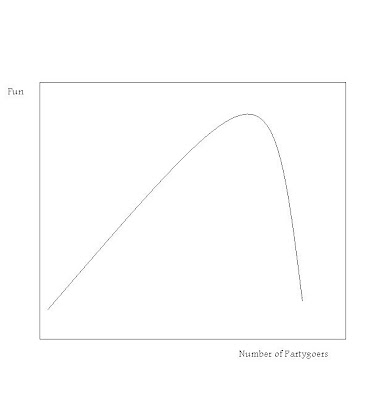 Note the steep drop-off at a certain point, when the number of partygoers reaches the maximum capacity of the party's physical location. Clearly people like a good party, but no one wants to get squished. As you can see, the appeal of a party is a function of the number of people already there, and this determines how many people will want to join that party in the future. The self fulfilling prophesy is in full effect. Because of this, the success or failure of a party depends largely on the number of people attracted in the initial stages, and this can depend largely on chance. When a party has reached a "tipping point" of popularity through word of mouth, it can fill up to the point of reaching the maximum capacity of the party's physical location. Then there will be spillover to the less popular parties, and a new equilibrium will be reached.
But what about a party with no physical location, other than tiny ones and zeroes occupying a server? Yes I am talking about the internet, and specifically the huge social gatherings that occur 24/7 on social networking sites like Facebook and Twitter. Just like a parties, these sites bring positive network externalities to their users. Meaning, the more people there are on Facebook, the more beneficial it is for a new person to join Facebook. But unlike parties, huge websites do not face the constraints of physical space. So, roughly graphing the benefit of being on a social networking website in response to number of users would look something like this:
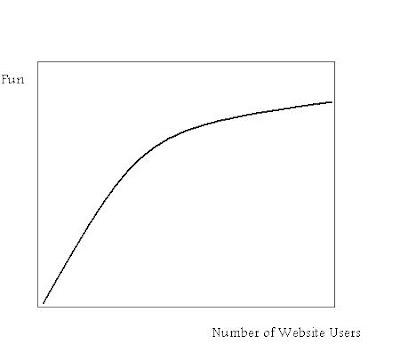 Rather than a drop in total fun occurring at the point of some number of users as we saw with the physical party, there is simply a levelling off. There are diminishing marginal returns to fun here, because, for example with Facebook, you can only have so many Facebook friends (5000 as of today I believe, and even fewer you really interact with on a regular basis). But there is no drop-off in benefit, because there is no restriction on capacity. Unlike a real physical party, this party on the internet shows no sign of slowing down. Facebook has become a fixture, and it would be very difficult for another company to come in and compete with it on its own turf. A new site would need to provide amazing new benefits to compete with the massive positive network externalities Facebook has built up through its user base. And why did Facebook build up such a large base of users? Partially because it's a very well designed site, but also because of the initial luck of the draw. Mark Zuckerberg's party got the initial rush of partygoers it needed to sustain itself and grow. Without any capacity restrictions, it seems to be here to stay. Even if there were a better party next door, people would probably ignore it.
Note the steep drop-off at a certain point, when the number of partygoers reaches the maximum capacity of the party's physical location. Clearly people like a good party, but no one wants to get squished. As you can see, the appeal of a party is a function of the number of people already there, and this determines how many people will want to join that party in the future. The self fulfilling prophesy is in full effect. Because of this, the success or failure of a party depends largely on the number of people attracted in the initial stages, and this can depend largely on chance. When a party has reached a "tipping point" of popularity through word of mouth, it can fill up to the point of reaching the maximum capacity of the party's physical location. Then there will be spillover to the less popular parties, and a new equilibrium will be reached.But what about a party with no physical location, other than tiny ones and zeroes occupying a server? Yes I am talking about the internet, and specifically the huge social gatherings that occur 24/7 on social networking sites like Facebook and Twitter. Just like a parties, these sites bring positive network externalities to their users. Meaning, the more people there are on Facebook, the more beneficial it is for a new person to join Facebook. But unlike parties, huge websites do not face the constraints of physical space. So, roughly graphing the benefit of being on a social networking website in response to number of users would look something like this:
Rather than a drop in total fun occurring at the point of some number of users as we saw with the physical party, there is simply a levelling off. There are diminishing marginal returns to fun here, because, for example with Facebook, you can only have so many Facebook friends (5000 as of today I believe, and even fewer you really interact with on a regular basis). But there is no drop-off in benefit, because there is no restriction on capacity. Unlike a real physical party, this party on the internet shows no sign of slowing down. Facebook has become a fixture, and it would be very difficult for another company to come in and compete with it on its own turf. A new site would need to provide amazing new benefits to compete with the massive positive network externalities Facebook has built up through its user base. And why did Facebook build up such a large base of users? Partially because it's a very well designed site, but also because of the initial luck of the draw. Mark Zuckerberg's party got the initial rush of partygoers it needed to sustain itself and grow. Without any capacity restrictions, it seems to be here to stay. Even if there were a better party next door, people would probably ignore it.Saturday, May 28, 2011
Value of a Bird in the Hand in Terms of Birds in Bushes
 Is a bird in the hand really worth two in the bush? A GEICO commercial, where an antiques appraiser values a sculpture of a bird in the hand as worth "two in the bush" got me thinking about that expression. Maybe a bird in the hand is really worth 3 or 5 birds in the bush. I'm no bird hunter, but I am an amateur economist, and I know to find the value of a bird in the hand in terms of birds in bushes, we can break it down mathematically. The expression "a bird in the hand is worth two in the bush" can be mathematically expressed by the following equation: valueOfBirdInHand = 2*valueOfBirdInBush
 But this is inadequate. To fully flesh out the economic wisdom contained in this colloquialism, we need several variables other than the number of birds dwelling in the bush. These variables are as follows: 1) The probability of catching a bird, given that it is in the bush.
2) The fixed costs involved with going bird-catching in the first place. By fixed costs, meaning the same amount of these costs must be incurred regardless of the bird-yield.
3) The variable costs that must be incurred per bird that is caught. Variable meaning that these costs increase per caught bird.2) The fixed costs involved with going bird-catching in the first place. By fixed costs, meaning the same amount of these costs must be incurred regardless of the bird-yield.
So adding in these variables, by my reckoning, the equation for the value of an attempt to hunt birds in the bush is:
totalValue= P(catching bird)*numBirds*unitValue - (numBirds*unitVariableCost) - fixedCost
with P(catching bird) denoting the probability of catching a bird given that it is in the bush. Unit value gives a measurement of value to a caught bird, for example the prevailing market rate for that particular bird.
To explain this perhaps perplexing equation, P(catching bird)*numBirds*unitValue gives the total expected value, meaning you might catch 50% of 10 birds valued at $20 each for $100 total yield, or 25% of 12 birds valued at $5 each for a $15 yield. NumBirds*unitVariableCost gets you your total variable cost. Subtract that out along with your fixed cost and you have the expected net value of your hunting trip. It's like an expected profit.
So to find the value of a bird in the hand, set totalValue to the value of a single bird, and solve for numBirds in the following equation: totalValue= P(catching bird)*numBirds*unitValue - (numBirds*unitVariableCost) - fixedCost
with P(catching bird) denoting the probability of catching a bird given that it is in the bush. Unit value gives a measurement of value to a caught bird, for example the prevailing market rate for that particular bird.
To explain this perhaps perplexing equation, P(catching bird)*numBirds*unitValue gives the total expected value, meaning you might catch 50% of 10 birds valued at $20 each for $100 total yield, or 25% of 12 birds valued at $5 each for a $15 yield. NumBirds*unitVariableCost gets you your total variable cost. Subtract that out along with your fixed cost and you have the expected net value of your hunting trip. It's like an expected profit.
P(catching bird)*numBirds*unitValue - (numBirds*unitVariableCost) - fixedCost = unitValue
Solving,
factor out numBirds and move fixedCost to other side,numBirds*(P(catching bird)*unitValue - unitVariableCost)=unitValue+fixedCost
divide both sides by (P(catching bird)*unitValue-unitVariableCost)) and we have our answer:
numBirds=(unitValue + fixedCost)/(P(catching bird)*unitValue-unitVariableCost)
This equation answers the question of how many birds in the bush equal the value of one bird in the hand! For example, let's say birds were worth $10 each, the probability of catching a bird in a bush was 0.50, and there were zero fixed or variable costs involved with bird catching. In this case:
numBirds = ($10 + 0)/(0.50*$10 - 0)
numBirds = 1/0.50
numBirds = 2
Thus in that situation a bird in the hand is worth two in the bush, just like the expression tells us.
But what if there were fixed and variable costs involved with hunting for birds? What if you needed to pay a $5 fee to go bird hunting, and it cost you $1.00 per bird to get it ready for market? Then:
numBirds = ($10+$5)/(0.5*$10-$1)
numBirds = 15/4numBirds = 3.75
So in this case a bird in the hand would be worth 3.75 birds in the bush.
Now what if, keeping the costs the same, the probability of catching a bird in a bush decreased to 0.25?:
numBirds=($10+$5)/(0.25*$10-1)
numBirds=15/1.5
numBirds=10
In this case a bird in the hand would be worth 10 birds in the bush.
So after all these mathematical gyrations you might think I'm being silly just like the GEICO commercial. Well, yes I am being silly but there are also valuable economic lessons to be learned here. You can replace "bird" with any other thing of value, and the simple economic model I have assembled here, as well as the wisdom of the expression it was based on, would be just as valid. The old saying examines one of the great conflicts in economic life: the sure thing vs. speculative gain. For more on that topic check out my article on the game show "Deal or No Deal".
The moral of the story is: to evaluate a decision, look at the probability of a favorable outcome, look at the variable costs, and look at the fixed costs.
Subscribe to:
Posts (Atom)