Saturday, June 18, 2011

The Invisibility Cloak: Bad for Human Rights?

There was some dramatic news last year. Scientists in Germany have apparently been getting very close to making an invisibility cloak. For the first time ever, through innovations in light-bending materials, a small object was made invisible from all angles. Though the technology is not yet usable in a Harry Potter-like fashion, the development of a cloak one could just throw on to become invisible may only be a few years away.
Now before all you sci-fi and fantasy fans go nuts, just ponder the question: what are the possible uses for an invisibility cloak? I think you'll come to the conclusion that an invisibility cloak would mostly be useful for two things: mischief and mayhem. If invisibility cloaks became widely available to the public, the crimes of peeping toms, shoplifters and murderers for example would all become easier to get away with. Which brings me to the subject of human rights. To understand the full ramifications of widespread invisibility, it's useful to become familiar with the idea in law and economics, of a mathematical equation for the "optimal punishment" for a crime. Donald Wittman's excellent textbook on law and economics explains this concept the best. Because not all criminals can be caught, in order to make them face the full costs their crimes bring upon society "...the expected punishment, probability of being punished (P) times the fine (F), is set equal to the harm of the crime. That is PF = H. Thus the lower the probability of being caught, the higher the level of punishment should be." In other words, for the legal system to adequately dissuade people from committing crimes, two things are possible: 1) increasing the probability of catching the criminal, or 2) increasing the punishment. So the necessary punishment F varies inversely with the probability of being caught. So if suddenly it were half as likely for someone to get caught for a particular crime, to maintain optimality, the punishment must become twice as harsh. This seems to explain at least in part why countries without advanced systems of crime detection and law enforcement (low P) may punish small crimes with huge punishments (high F, e.g. cutting off someone's hand for shoplifting, or hanging, drawing and quartering for various crimes in medieval England).

So what does this have to do with invisibility cloaks? Clearly, (no pun intended), if invisibility cloaks became cheap and widely available to criminals,  the probability of getting caught (the P in the optimal punishment equation), for many crimes would decrease. Most crimes would become easier to get away with by use of an invisibility cloak. But not only would it help in the perpetration of crimes, an invisibility cloak would help people resist arrest for any crime, even those not utilizing invisibility, such as cybercrime and fraud perhaps. If the cops came to your door, you could just slip on your invisibility cloak and make a break for it.
So in a world of widespread invisibility crimes, to once again make criminals fully face the costs they bring to society, the legal system could greatly increase F, the punishment, or alternatively attempt to bring P back up to its original levels, perhaps by becoming ever more invasive into peoples lives. Either way an invisibility cloak sounds like bad news, both for the possible victims of invisibility related crimes and for human rights in general. I personally wouldn't want shoplifting a pack of gum to be punishable by years in prison just because pesky invisible people have ruined the legal system for everybody.
Haven't these scientists seen "Hollow Man" or "Predator"?

Sources:
http://articles.nydailynews.com/2010-03-20/news/27059544_1_invisibility-cloak-dimensions
 Donald Wittman, Economic Foundations of Law and Organization, Cambridge University Press, 2006
Tuesday, June 14, 2011

Party-nomics, Facebook and Positive Network Externalities

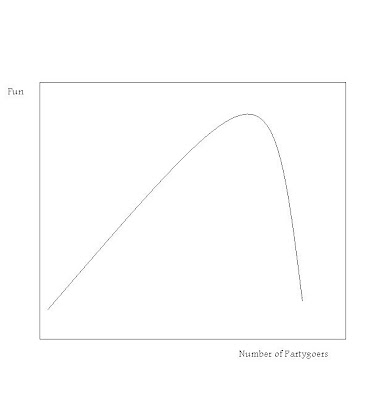
Have you ever been party-hopping with friends, found a party or a bar that wasn't highly occupied, and then (maybe due to a unanimous decision, or maybe due to the whining of a few) immediately left to seek a more popular venue? If so, you have helped fulfill a self fulfilling prophesy. In this kind of situation, if more people are willing to stick around at the unpopular venue, it can have had a chance to become popular. But with everyone leaving 5 minutes after getting there, the place will remain, in the parlance of our times, "dead" (as in "dude, this party is dead, let's split"). This phenomenon is very well described by what economists call "positive network externalities". Unlike a good without positive-network externalities such as a banana, where one person's benefit from eating a banana does not depend at all on how many other people eat bananas, a person's benefit from going to a party greatly depends on how many other people go to that particular party. This is because as another person joins the party, benefits (positive externalities) go to all the other partygoers. The more people there are at the party, the more chances there are for exciting social encounters. Therefore there is more benefit both for people already at the party as well as for prospective partygoers. This self-fulfilling prophesy will attract people to the party up to the point when things get overcrowded. After this point, each person's benefit will actually decrease as each additional partygoer arrives. With the number of partygoers on the x axis, and the individual enjoyment of the party on the y axis, a graph of the "total fun" of a party (if we could quantify it) would look something like this:
Note the steep drop-off at a certain point, when the number of partygoers reaches the maximum capacity of the party's physical location. Clearly people like a good party, but no one wants to get squished. As you can see, the appeal of a party is a function of the number of people already there, and this determines how many people will want to join that party in the future. The self fulfilling prophesy is in full effect. Because of this, the success or failure of a party depends largely on the number of people attracted in the initial stages, and this can depend largely on chance. When a party has reached a "tipping point" of popularity through word of mouth, it can fill up to the point of reaching the maximum capacity of the party's physical location. Then there will be spillover to the less popular parties, and a new equilibrium will be reached.
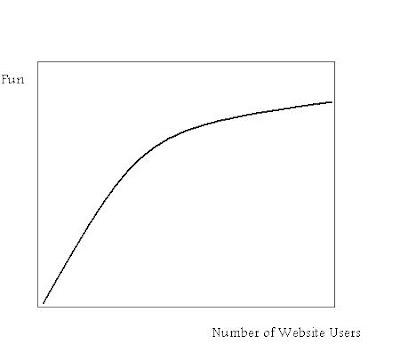
But what about a party with no physical location, other than tiny ones and zeroes occupying a server? Yes I am talking about the internet, and specifically the huge social gatherings that occur 24/7 on social networking sites like Facebook and Twitter. Just like a parties, these sites bring positive network externalities to their users. Meaning, the more people there are on Facebook, the more beneficial it is for a new person to join Facebook. But unlike parties, huge websites do not face the constraints of physical space. So, roughly graphing the benefit of being on a social networking website in response to number of users would look something like this:
Rather than a drop in total fun occurring at the point of some number of users as we saw with the physical party, there is simply a levelling off. There are diminishing marginal returns to fun here, because, for example with Facebook, you can only have so many Facebook friends (5000 as of today I believe, and even fewer you really interact with on a regular basis). But there is no drop-off in benefit, because there is no restriction on capacity. Unlike a real physical party, this party on the internet shows no sign of slowing down. Facebook has become a fixture, and it would be very difficult for another company to come in and compete with it on its own turf. A new site would need to provide amazing new benefits to compete with the massive positive network externalities Facebook has built up through its user base. And why did Facebook build up such a large base of users? Partially because it's a very well designed site, but also because of the initial luck of the draw. Mark Zuckerberg's party got the initial rush of partygoers it needed to sustain itself and grow. Without any capacity restrictions, it seems to be here to stay. Even if there were a better party next door, people would probably ignore it.

Saturday, May 28, 2011

Value of a Bird in the Hand in Terms of Birds in Bushes

Is a bird in the hand really worth two in the bush? A GEICO commercial, where an antiques appraiser values a sculpture of a bird in the hand as worth "two in the bush" got me thinking about that expression. Maybe a bird in the hand is really worth 3 or 5 birds in the bush. I'm no bird hunter, but I am an amateur economist, and I know to find the value of a bird in the hand in terms of birds in bushes, we can break it down mathematically. The expression "a bird in the hand is worth two in the bush" can be mathematically expressed by the following equation: valueOfBirdInHand = 2*valueOfBirdInBush
But this is inadequate. To fully flesh out the economic wisdom contained in this colloquialism, we need several variables other than the number of birds dwelling in the bush. These variables are as follows: 1) The probability of catching a bird, given that it is in the bush.
2) The fixed costs involved with going bird-catching in the first place. By fixed costs, meaning the same amount of these costs must be incurred regardless of the bird-yield.
3) The variable costs that must be incurred per bird that is caught. Variable meaning that these costs increase per caught bird.
So adding in these variables, by my reckoning, the equation for the value of an attempt to hunt birds in the bush is:
totalValue= P(catching bird)*numBirds*unitValue - (numBirds*unitVariableCost) - fixedCost
with P(catching bird) denoting the probability of catching a bird given that it is in the bush. Unit value gives a measurement of value to a caught bird, for example the prevailing market rate for that particular bird.
To explain this perhaps perplexing equation, P(catching bird)*numBirds*unitValue gives the total expected value, meaning you might catch 50% of 10 birds valued at $20 each for $100 total yield, or 25% of 12 birds valued at $5 each for a $15 yield. NumBirds*unitVariableCost gets you your total variable cost. Subtract that out along with your fixed cost and you have the expected net value of your hunting trip. It's like an expected profit.
So to find the value of a bird in the hand, set totalValue to the value of a single bird, and solve for numBirds in the following equation:
P(catching bird)*numBirds*unitValue - (numBirds*unitVariableCost) - fixedCost = unitValue
Solving,
factor out numBirds and move fixedCost to other side,
numBirds*(P(catching bird)*unitValue - unitVariableCost)=unitValue+fixedCost
divide both sides by (P(catching bird)*unitValue-unitVariableCost)) and we have our answer:
numBirds=(unitValue + fixedCost)/(P(catching bird)*unitValue-unitVariableCost)
This equation answers the question of how many birds in the bush equal the value of one bird in the hand! For example, let's say birds were worth $10 each, the probability of catching a bird in a bush was 0.50, and there were zero fixed or variable costs involved with bird catching. In this case:
numBirds = ($10 + 0)/(0.50*$10 - 0)
numBirds = 1/0.50
numBirds = 2
Thus in that situation a bird in the hand is worth two in the bush, just like the expression tells us.
But what if there were fixed and variable costs involved with hunting for birds? What if you needed to pay a $5 fee to go bird hunting, and it cost you $1.00 per bird to get it ready for market? Then:
numBirds = ($10+$5)/(0.5*$10-$1)
numBirds = 15/4
numBirds = 3.75
So in this case a bird in the hand would be worth 3.75 birds in the bush.
Now what if, keeping the costs the same, the probability of catching a bird in a bush decreased to 0.25?:
numBirds=($10+$5)/(0.25*$10-1)
numBirds=15/1.5
numBirds=10
In this case a bird in the hand would be worth 10 birds in the bush.
So after all these mathematical gyrations you might think I'm being silly just like the GEICO commercial. Well, yes I am being silly but there are also valuable economic lessons to be learned here. You can replace "bird" with any other thing of value, and the simple economic model I have assembled here, as well as the wisdom of the expression it was based on, would be just as valid. The old saying examines one of the great conflicts in economic life: the sure thing vs. speculative gain. For more on that topic check out my article on the game show "Deal or No Deal".
The moral of the story is: to evaluate a decision, look at the probability of a favorable outcome, look at the variable costs, and look at the fixed costs.

Sunday, April 24, 2011

False Quantity Discounts and Chocolate Bunnies

Almost two years ago I wrote an article about drugstores offering false quantity discounts. By false quantity discount, I mean that if the price tag said "10 for $10" you didn't need to buy a quantity of 10 to get the discount. You could buy one for one dollar, two for two dollars, eight for eight dollars or any variation thereof. This dishonest and lazy policy struck me as harmful, not so much to customers, but to the retailers' revenues. Under a system of false quantity discounts, assuming customers believe what the price tags say (though I'm sure many are savvy to the policy by now), if a customer chooses to buy fewer than the (false) required quantity, the retailer needlessly loses money on the transaction. These customers are willing to buy the item, but unwilling to buy it in such a quantity that, they think, would earn them a discount. But when they get to the cash register, CHA CHING! they get the discount anyway. These surprise discounts reduce revenue. And the retailers who have their Point of Sale systems set up like this are leaving money on the table. To illustrate the foolishness of such a policy I'll tell you about my shopping expedition to a Rite-Aid the other day. At Rite-Aid there was a sale on chocolate bunnies. "2 for $3" it said:
Knowing there was a chance that this Rite-Aid didn't have a POS system sophisticated enough to handle a real quantity discount, and hungry for a bunny, I bought just one item. And just as I had guessed, this wasn't a real quantity discount, just a re-setting of the price to $1.50 per unit. Here's the proof:

(Disregard that I was also buying earplugs and a glasses case that, as it turns out is not intended for my gender. Chocolate bunny is line three.)
As you can see, not only was it unneccessary for me to buy two rabbits to get the discount, but I also got that one rabbit cheaper than advertised. This begs the question: why would a retailer ever sell something for cheaper than advertised? I've heard of bait and switch, but this is like bait and switch in the customer's favor. The only reason for a policy such as this must be that some retailers choose not incur the costs of implementing and maintaining more detailed POS system that can handle a quantity discount. Not knowing what the costs are, I can't judge whether this is the right or wrong choice. All I know is that such a policy lowers revenue.

So yes, my savvy shopping prevented me from buying an extra chocolate bunny I didn't really need, just to get a discount I would have received anyway. But this article is not about me. This is about the customers who go to Rite-Aid thinking they would need to buy two bunnies to get the discount, choose to buy just one bunny instead, and then get the discount anyway. These customers are willing to give up more of their money, but the retailers who follow this lazy policy are choosing not to take it. What's up with that? I've seen a few drugstores and grocery stores who have POS systems that implement real quantity discounts. I'm sure in the long run this will help them to do better than companies taking the dishonest and lazy path. Dishonest and hardworking? That can work. But dishonest and lazy is not a recipe for success.

Friday, April 8, 2011

Why Bubbles are Bad: The Long Term


Thinking about the word "bubble", describing bouts of speculative mass hysteria by investors creating a self-fulfilling prophesy of rising asset prices out of line with an asset's fundamental value, I've realized that the analogy of "bubble" is not perfect. In one very important way a speculative bubble is more like a sponge. Like sponges, speculative frenzies soak up investment, taking it away from what is truly value-creating. But never mind the metaphors, the point is that when investment gets pumped into one sector that, as it turns out in retrospect, was downright bubblicious, other actually valuable sectors get ignored, and this has significant consequences for the economy in both the short and long term.

I theorize that the amount of long-term havok a bubble unleashes on an economy is directly related to how long that bubble survives. Let me explain. If a bubble is around briefly, it's impact will mostly be limited to those who directly traded in the bubbly asset. But when a bubble thrives for years at a time, as was the case with the housing market in the 2000s, people not directly involved with the buying and selling of the asset have time to react and make fateful long-term investment decisions based on skewed bubble-induced perceptions. When I say the word "investment" I am not just talking about Wall Street. Every person in the world makes investments whenever they sacrifice something in the short term in anticipation of greater value in the future. Going to the gym is an investment. Planting seeds in the ground is an investment. And importantly for our discussion of bubbles, getting an education or putting years of labor into a certain professional field, is an investment. Unfortunately these long term investment decisions are often at the mercy of bubbles.

A bubble with staying power is a huge collective distraction. People gravitate toward numerous bubble-spawned careers, investing their precious years and dollars in them. During the housing and financial bubble of the 2000s, a great number of our best and brightest were whisked away from careers in engineering and medicine, and into the bubbly financial sector. According to The Harvard Crimson, in 2007, 47% of jobs taken by new Harvard grads were with consulting and financial firms. The bubbly influx of cash into these sectors allowed firms to hire extensively, and from the college graduates' perspective, seeing successful financial professionals popping up around them, finance was where the money was. One study of the financial sector by economist Thomas Phillipon at the Stern School of Business, using a statistical model, estimated that on average, bankers in 2006 were overpaid by 40% over what fundamental variables would precict. And wouldn't you like to be overpaid by 40% too? But the carnage occurs once the perceived value of the bubbly asset realigns with its actual value. At this point many of those who had found careers in the bubbly industry get sacked, and having spent years of their lives chasing an economic mirage, it becomes harder for them to contribute to the economy with real value-creating activity. Post bubble, huge sections of the labor force are stuck with skills that are no longer needed. And then what does the economy get? Higher structural unemployment, (the worst kind), and an economy unable to deal with the real challenges of its age.

To give another historical example, the most absurd Monty Pythonesque asset bubble I can think of occurred from 1634 to 1637, when Holland was struck with a collective frenzy for tulip bulbs. This speculative rush elevated the price of some rare types of tulip bulbs to monumental sums of money. The price of the coveted "Admiral Van Eyck" bulb increased from 1,500 guineas in 1634 to 7,500 guineas in 1637, which at the time was the price of a house. Of course a crash in prices followed shortly after. But for those three years, i'm sure it was very lucrative to be in the tulip industry. If such a bubble were to happen today we'd probably see commercials for money-grubbing trade schools on TV saying "Get in on the fastest growing career: Tulip Merchant." It sounds absurd in hindsight. Bubbles always do. But it always seems like a good idea at the time.

I guess the moral of the story is, in all economic behavior, from choosing a stock to buy to choosing a house, to choosing a career: Don't Believe The Hype.

Sources:

Olivier Blanchard, Macroeconomics, Fourth Edition, 2006, Pearson/Prentice Hall , Pg. 328 http://www.thecrimson.com/article/2008/6/22/harvard-graduates-head-to-investment-banking/#

Monday, March 28, 2011

Can You Make Sense Of This Chart?


Have you ever seen a commercial for some kind of financial service showing people on computerized trading platforms with more blinking lights and features than the Starship Enterprise? Or have you ever watched CNBC and been sensorially overloaded by the massive array of ticking stock data and colorful charts? It all looks very fancy and impressive, but it's just that: fancy and impressive. These images of sophisticated trading systems are designed to perpetuate the myth of the financial superhero, looking at his charts, making trades, producing miraculous results. Real successful investing is a lot less exciting. Sure, it would be fun to be a financial superhero, recognizing patterns in the market that all others didn't see, clicking your mouse and nailing down huge, market-beating profits. This is the fantasy that companies like E*Trade want customers to believe in, and it was one E*Trade commercial I saw months ago that prompted me to write this article in the first place. The commercial plays like a manifesto for active investment strategies. "Sitting, waiting, hoping. That's a recipe for failed investing," says the commercial's voice-over, heard over an image of a flatlining EKG screen, I suppose to emphasize that passive investment strategies are dead, or will kill your portfolio.

But is this true? No. Sitting, waiting and collecting dividends can often be more profitable than speculation. In fact, my understanding is that in general, long term buy and hold strategies are far more lucrative than frantic trading based on price fluctuation. Just ask Warren Buffett. To quote the world's most successful investor "I realized technical analysis didn't work when I turned the charts upside down and didn't get a different answer." So, if that negative view of chart-watching is held by such a successful investor as Warren Buffett (and the majority of academics in the field of finance) why do we see so many charts on commercials for E*Trade?

It's because E*Trade has something to gain. The company gets a fee for every trade their customers make. So it's only natural for E*Trade to try to convince its customers that profit opportunities slip through their fingers every second they are not trading. Because trading volume is the source of E*Trade's revenues, it would like its customers to treat investing like a video-game, or perhaps a slot machine. If customers keep pulling that handle, E*Trade makes money. Hence the fun looking interface and colorful graphs.

The new features of E*Trade's online trading platform supposedly provide the user with expert advice and analysis to help them "seize opportunities" (Cut to fancy charts and buttons!). E*Trade says this advice is unbiased, and I hope that's true. But judging from the pop-finance mumbo-jumbo of their commercials, I'd take E*Trade's advice with a big grain of salt. Perhaps a container of Morton's. Admittedly I'm no investment expert, but common sense and some finance textbooks have told me that no human being could extract usable information from the massive amounts of effectively random price data running across the screen on a fancy trading platform or CNBC broadcast. Perhaps a superhero could. But as we are merely human beings, it might be better to put the charts aside, sit back, relax and collect some dividends.

Here's a link to the E*Trade commerical if you're interested.

Monday, February 21, 2011

An Increase in the Supply of Embarrassment


Since the advent of mass communication technologies, it has gotten a lot easier to be embarrassed. Especially in the age of Youtube, TIVO, cameraphones and widespread video surveillance, if anyone does something embarrassing, there is the potential for a viral phenomenon spreading that embarrassment across the globe.
So should everyone live in a constant state of fear of messing up in front of a camera (e.g. Cristina Aguilera and "the twilight's last reaming")? Don't worry, here comes economics to the rescue!
Economics is the study of the allocation of scarce resources. It's an fundamental principal in economics that when a resource becomes less scarce, each unit of the resource will be individually less valuable. Just think of a world where bountiful apple trees grew on every street corner. How much would people be willing to pay for apples? Not much, because they could just grab them off of the nearest tree.
As it turns out, the internet is a bountiful tree of embarrassing moments ready to be picked. So is embarrassment a resource that people buy and sell? Yes. Though websites like Youtube and Break.com are ostensibly free, every day millions of people exchange their time for the opportunity to watch funny videos, often of real people embarrassing themselves. (To be honest, this is one of the main reasons I watch Youtube. Forget about videos with actors and scripts, I think there's nothing funnier in the world than game show bloopers.) So if the embarrassment of others is a resource that is bought and sold, what would happen if the supply of embarrassing moments captured on film were to greatly increase? Just as with an increase in the supply of apples, if embarrassing videos become less scarce, each embarrassing video would become individually less valuable.
And this is exactly what has happened. Because of Youtube and other technological developments, consumers now have unprecedented access to viewing others' embarrassing moments. But this increase in supply must interact with consumers' demand preferences, and this can be represented with a basic supply and demand model. Because internet users do not pay a monetary value per viewing, we cannot speak simply of price as we could in the market for apples. However each internet viewer does place an individual measure of value on each viral video he/she watches. Likewise those who submit videos get satisfaction based upon the number of hits a video receives. The price that viral video viewers give up and suppliers receive as revenue, is hard, if not impossible to quantify, but the behavior is identical to the supply and demand for any other good. So just to give the general idea, here's a graph depicting the supply of and demand for embarrassing viral videos, with P being that unquantifiable value of satisfaction that people receive from both submitting and watching these videos, and Q being the quantity of videos available:

As you can see, the supply curve has shifted outwards as technology makes a greater quantity of embarrassing videos available. This increases the quantity viewed from Q1 to Q2, but also decreases the value that people place upon each individual embarrassing videos from P1 to P2. This can be very intuitively understood. If there were suddenly twice as many videos of, say, ballroom dancing accidents, each individual video will be less special to each consumer. There are only so many ballroom dancing accident videos consumers will be able to watch within their schedules. With an increased supply, the level of cultural saturation each individual viral video achieves is nothing like the earlier days of the internet. With an increase in supply, viral videos as a whole become more prevalent, but each individual video becomes less distinctive and culturally valued.
So what does this economic reasoning mean for those who have been and will be embarrassed by viral videos? Basically it's good news. While new technologies have made it so much easier to be embarrassed in front of a global audience, the abundance of supply will keep the cultural value of each embarrassing moment low, to the point that new videos may not have the universal appeal of earlier ones that became global phenomena. This decrease in cultural value and recognition in turn makes each embarrassing viral video less embarrassing. For this reason, people, especially public figures who are constantly in front of cameras, should not live in fear of slipping up and becoming the next embarrassing viral phenomenon. Excessive carefulness can be a hazard, especially in politics where the cameras are always rolling. People should act naturally as ever. Because in the future, as the internet continues to churn out mountains of content, the public's reaction to a possible viral phenomenon may just be "meh".

Its a new age where everything is out there for all to see. But that gets boring after a while, doesn't it?

Friday, January 28, 2011

EBT (food stamps) and Fast Food: Implications for Market Demand


At some point in 2010 I started noticing different fast food restaurants in California, both in the SF Bay Area and Los Angeles County offering to accept payment via EBT (Electronic Benefits Transfer for food stamps programs). This is a change from the prior rules wherein EBT could only be used for unprepared food e.g. from the grocery store. Now under different programs such as Los Angeles County's Restaurant Meals Program, it is now possible to use food stamps to get fast food, e.g. pizza from Pizza Hut. Before I get into the possible positive and negative effects of this change in policy I want to explain the effects of this change on the market equilibrium for fast food.
In short, this change in policy creates a kink in the demand curve for fast food, as low income EBT recipient customers increase their demand, while demand by higher income customers does not change.
Consider two fast food buying customers. Person A earns an income that disqualifies him from EBT. Person B earns a low enough income to qualify for EBT, and has chosen to receive those benefits.
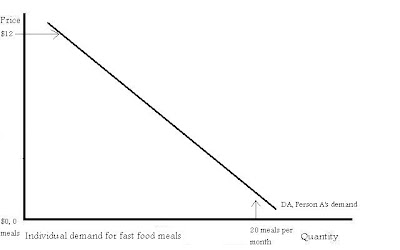
Here is person A's demand curve:

You can see that if fast food was practically free, Person A would consume 20 meals per month. Also notice how, because he has the budgetary capacity, at a price of $12 per fast food meal, Person A would still buy a small quantity of fast food per month at this high price.
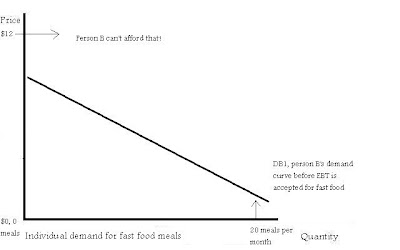
Now consider Person B's more modestly budgeted demand curve. This is person B's demand for fast food meals before the change in policy that allows him to purchase fast food with EBT.

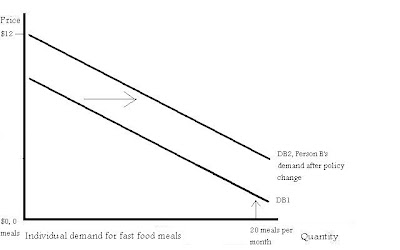
Notice how at a price of $12 per meal Person B will not buy any fast food meals. This is beyond his budget at this point. So what happens to Person B's demand curve when suddenly he can use EBT to purchase these meals? This change in policy will shift his demand curve for fast food to the right, because he will now be more able to purchase fast food meals at various prices. Here's his new demand curve:


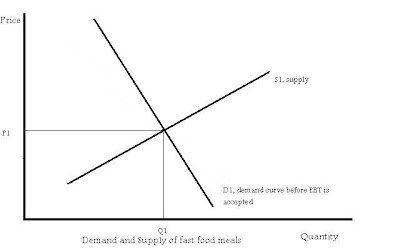
We have now seen the effects of this change in policy on two individuals, one on food stamps and one not. But what about the market demand curve? And what does this mean for market equilibrium (the point where the quantity demanded equals the quantity supplied)? Let's find out. Because the market demand curve is the summation of all the individual demand curves, just imagine adding together all the demand curves for all the Person A-s and Person B-s of the market. Let's say the demand and supply curves before the policy change look like this:
The market price is at P1 and the quantity sold is at Q1. Suddenly the county government for this market allows EBT to be used to buy fast food. What would this do to the demand curve? Because higher income, non-food-stamp recipient customers like person A can affect the entire market demand curve, from the highest prices to the lowest, and lower income food-stamp recipient customers like person B would tend to only affect the lower parts of the demand curve, when EBT is suddenly allowed for fast food purchases, it is only the lower parts of the demand curve that will shift outward (in reality the change would probably not be this prominent but I have made it prominent just for demonstration). Here is the new market demand curve:
The result is a kink in the demand curve pushing out at the point where most food stamp recipients would be priced out of the market. Assuming the supply curve is below that point, this increases the equilibrium price to P2 and the equilibrium quantity to Q2. Thus this policy is a good thing for fast food companies, increasing their revenue by the amount of:
(P2*Q2)-(P1*Q1)
So what is the significance of the kink in the demand curve? Probably nothing in today's market, because fast food prices usually stay so much in the lower level that the portions of the demand curve higher than the kink will not come into play. In effect the shift is probably more like a shift of the entire demand curve, because the upper reaches may not even matter for equilibrium. However, if there were suddenly massive supply shocks in the inputs for the supply of fast food, e.g. global potato crop failure, the price might go high enough that more and more Person B-s actually get priced out. Let's hope that doesn't happen anytime soon. Nonetheless it's interesting and worth noting that (at least according to my reasoning) the whole demand curve does not shift, just the lower portion.
Now that I've looked at my graphs, what do I think of this policy?
I'm conflicted on this issue. Fast food is usually bad for you (except for the notable example of Subway). Nonetheless, a food stamp recipient can find food that is just as bad at the local grocery store. There is nothing in the law to prevent a food stamp recipient from using EBT to eat nothing but sticks of butter and Captain Crunch cereal. Also, for homeless food stamp recipients, lacking kitchen tools, buying prepared food can be the easiest way to get a hot meal. The issue here is how paternalistic does one want their government's social welfare programs to be? There is no demand and supply diagram that can easily find the best answer to this question. From my political preference, I am more on the side of allowing EBT purchases of prepared food. Not all of the poor will give themselves heart disease because of this policy change. Some will. But really this is a seperate issue. More nutritional education, (Public Service Announcements etc.) is the key to getting people to demand less junk food in the first place. Thus the "invisible hand" would force fast food companies to offer better choices. Ever since the movie "Super Size Me", I think we've already seen this happening.
I honestly don't know what the best policy is in this case. All I can say is, from just looking at the demand and supply curves, this is a great policy for fast food companies' profit margins. It is also bad for the profit margins of grocery stores who no longer have a monopoly on EBT food transactions.

Monday, January 24, 2011

How Not to Package Your Product


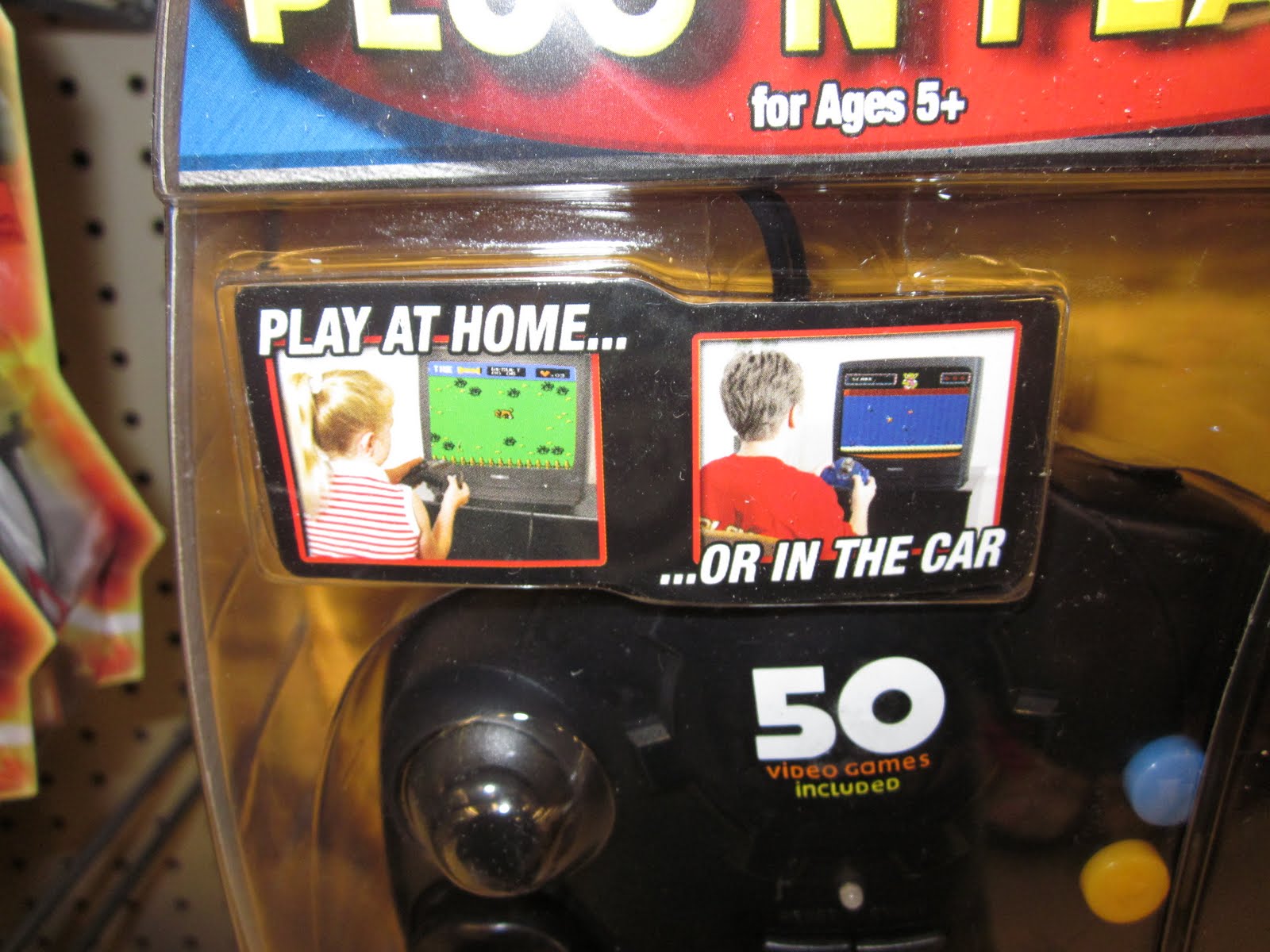
What's wrong with this picture?

Okay, I admit it. This article is not my best example of hard hitting in-depth economic analysis. Its more an excuse for me to post a funny picture I took at a Walgreens today, (kind of like my last article about that bizarre viral billboard campaign). However, I will say that this picture, taken from the package of a bargain plug-in video game console, is a great example of how not to package a product. Just one more quality-control step could have prevented this confusing and humorous design choice. Sometimes all it takes is a second pair of eyes to notice something like this.

Or perhaps this wasn't a mistake. In the rush to bring this bargain product to market, the packaging team might not have had time to take (or photoshop) a picture of a kid playing the game plugged into a backseat television screen, and whoever gave the go-ahead on the package design just said "eh, that's good enough." Whatever the case, the result is a barrel of laughs!

But I'll take this a step further. I think this kind of mistake is emblematic of the "death of the proofreader" a phenomenon brought about by the advent of spelling and grammar checking software. I am not an anti-spellcheck luddite, but it's just a matter of fact that before spellcheck and grammarcheck, a second pair of eyes was a necessary part of copy writing for packaging and other media. But that second pair of eyes can be expensive, and for many tasks, digital checking can be superior. However, problems arise because computers cannot easily deal with the meanings behind words. For example, to a spelling and grammar checker the sentences "They had a fight" and a corresponding typo "They had a fig" are equally valid. It would take a proofreader to recognize that error, just as it would take a proofreader to recognize that the kid in the second picture is playing his game on a tv stand, which is rather hard to do in a car.

(I sure hope there are no typoes in this article.)

Thursday, January 13, 2011

Weirdest Billboard Ever?


I was driving in West Los Angeles today when I came across a billboard so strange I could hardly believe my eyes. From a distance I could see the words "Win a Free Booby Prize", next to an image of a voluptuous woman. At first I thought this was some kind of off-color strip club or plastic surgery advertisement. Boy was I shocked when I drove closer and saw that that the woman on the billboard had a blurred Jesus face!!!!!
So, why does this belong on an economics blog? It does because this is a great example of today's trend towards "viral" marketing. The makers of this billboard, whether they are plastic surgeons or eccentric Christian missionaries, are counting on people like me being so baffled by this ad campaign that they will go to "freeboobyprize.com" to find out what the heck is going on. And by posting this picture and writing about this I am playing right into their hands. But I can't resist. It is too bizarre to ignore.
This may turn out to be a success for whatever organization put this billboard up. I'm certainly curious. And if it is a success, there may be imitators with even more shocking and baffling billboards. But to return to a theme I've been talking about a lot lately, this type of bizarro billboard campaign would probably only be successful a few times. Imitators would face diminishing returns as the novelty of such ad campaigns wore off among the public.
So what is Free Booby Prize? I'm curious, but perhaps not curious enough to go to their website, because then I would officially be a sucker to this billboard.